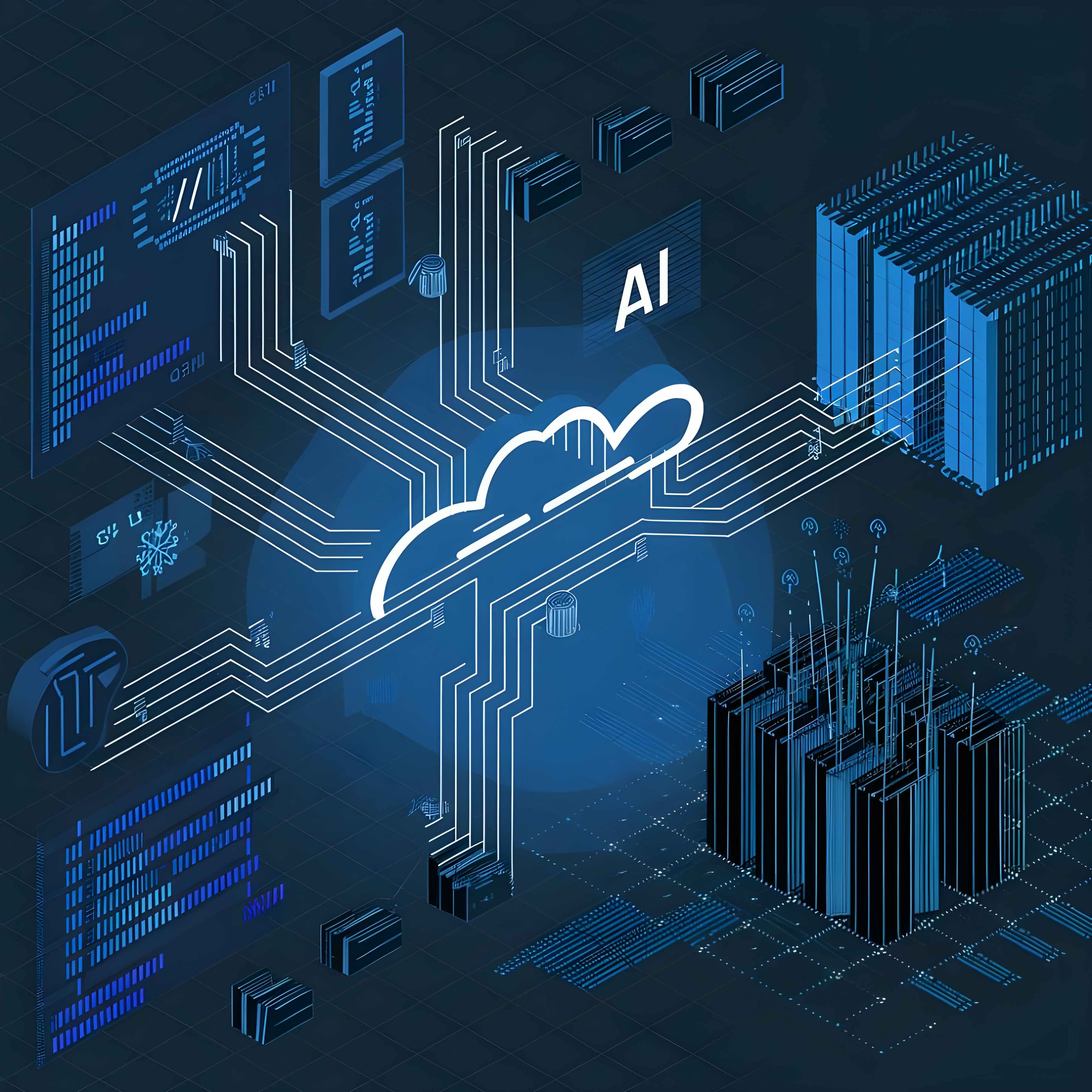
Designing Cloud Infrastructure for AI Workloads: What Enterprise Teams Need to Know
AI workloads are fundamentally different from traditional enterprise applications — in their compute demands, data requirements, latency profiles and cost structures. Cloud infrastructure designed for yesterday's workloads will constrain your AI ambitions tomorrow.
Executive Summary
Cloud infrastructure has become the default platform for enterprise AI. The elastic compute, managed data services, purpose-built AI accelerators, and global distribution capabilities that cloud platforms provide are simply not replicable in on-premises environments at comparable economics.
However, not all cloud infrastructure is equally suited to AI workloads. The compute, networking, storage and data architecture requirements of AI — particularly at enterprise scale — are meaningfully different from those of traditional applications. Organisations that attempt to run AI workloads on infrastructure designed for conventional enterprise systems will encounter performance bottlenecks, unsustainable cost structures, and operational complexity that limits their ability to move from pilot to production.
This article examines the specific infrastructure requirements of enterprise AI workloads, the cloud architectural patterns that best support AI at scale, and the cost management and governance disciplines required to make cloud AI economically sustainable.
How AI Workloads Differ from Traditional Enterprise Applications
Understanding why AI requires a different infrastructure approach requires understanding what makes AI workloads distinctive.
Compute intensity. Training large AI models requires massive parallel compute — typically GPU or specialised AI accelerator hardware that can perform the linear algebra operations underlying neural network training at scale. A single training run for a large language model may consume thousands of GPU-hours. Even inference workloads — serving predictions from trained models — can require GPU infrastructure for low-latency applications. Traditional CPU-based compute is insufficient for most AI training workloads.
Extreme data movement requirements. AI training requires feeding large volumes of data to compute continuously at high throughput. Bottlenecks in data transfer — between storage and compute, or between components of a distributed training cluster — can negate the benefits of powerful GPUs. Network bandwidth and storage I/O performance are critical infrastructure parameters for AI, often more so than for traditional applications.
Variable and bursty demand profiles. AI model training is often a batch workload — intensive for the duration of a training run, then dormant. AI inference can be highly variable, with demand patterns driven by end-user behaviour. Infrastructure that is sized for peak demand will be significantly underutilised at other times, creating cost inefficiency. Cloud elasticity — the ability to provision compute on demand and release it when not needed — is particularly valuable for AI.
Stateful, long-running training jobs. Training jobs may run for hours or days. Infrastructure failures mid-training can require jobs to restart from scratch, wasting compute spend. Checkpoint and resume capabilities, and infrastructure reliability at the level required for long-running jobs, are important considerations.
Heterogeneous workload mix. An enterprise AI platform typically runs multiple workload types simultaneously: batch training jobs, real-time inference APIs, data preprocessing pipelines, experiment tracking services, and monitoring infrastructure. Each has different compute, memory, networking and latency requirements. Managing this heterogeneous workload mix efficiently requires sophisticated orchestration.
Cloud Architectural Patterns for AI
GPU and Accelerator Infrastructure
The foundation of AI training infrastructure is purpose-built accelerator hardware. Major cloud providers — AWS, Microsoft Azure, Google Cloud, and Alibaba Cloud — offer GPU instances based on NVIDIA H100, A100 and other high-performance chips, as well as their own proprietary AI accelerators (AWS Trainium/Inferentia, Google TPU).
For most enterprise AI workloads, NVIDIA GPU instances provide the broadest compatibility with AI frameworks (PyTorch, TensorFlow) and the largest ecosystem of optimised libraries. For organisations with high-volume inference workloads, cloud-provider proprietary accelerators can offer better price-performance at scale.
Instance selection for AI workloads requires balancing GPU memory capacity (which determines maximum model size), interconnect bandwidth (critical for multi-GPU training), and cost per GPU-hour. Spot or preemptible instances — available at significant discounts in exchange for the possibility of interruption — can reduce training costs substantially for fault-tolerant workloads.
Distributed Training Architectures
Training large AI models — particularly foundation models and large language models — requires distributing the training workload across multiple GPUs, often across multiple nodes. Distributed training introduces networking requirements that differ significantly from typical enterprise applications.
High-bandwidth, low-latency interconnects between GPU nodes — such as AWS EFA (Elastic Fabric Adapter), NVIDIA InfiniBand, or Azure InfiniBand — are essential for efficient multi-node training. Without appropriate interconnects, communication overhead between nodes can negate the parallelism benefits of distributed training.
Cloud-native distributed training services, such as AWS SageMaker distributed training or Azure Machine Learning's distributed compute capabilities, abstract some of this complexity and provide managed infrastructure for common training patterns.
AI-Optimised Storage
Storage for AI workloads must balance several competing requirements: the capacity to store large training datasets and model artefacts, the throughput to feed data to GPUs continuously without bottlenecks, and the cost efficiency to make large-scale AI economically viable.
Cloud object storage (AWS S3, Alibaba Cloud OSS) provides cost-effective storage for large training datasets and model artefacts. However, for training workloads that require high-throughput random-access to training data, purpose-built high-performance file systems — such as AWS FSx for Lustre or Azure HPC Cache — may be required to eliminate data loading bottlenecks.
For inference workloads, model loading latency is a critical consideration. Models that are too large to fit in GPU memory require streaming from storage, which can introduce unacceptable latency for real-time applications. Model quantisation and distillation techniques can reduce model size, improving inference economics and latency.
Multi-Cloud and Hybrid AI Strategies
Many enterprise organisations operate across multiple cloud providers — for resilience, regulatory compliance, or because different providers offer advantages for different workloads. AI workloads add complexity to multi-cloud strategies, because training data, trained models and inference infrastructure must all be co-located (or connected with sufficient bandwidth) to avoid prohibitive data transfer costs and latency.
For organisations with data sovereignty requirements — where training data cannot leave specific jurisdictions — hybrid cloud architectures that bring AI compute to where the data resides may be necessary. Cloud providers offer managed on-premises hardware options (AWS Outposts, Azure Stack) that can support AI workloads in constrained environments.
AI Inference Infrastructure
Inference — serving predictions from trained models to end users or downstream applications — has different infrastructure requirements from training. Latency requirements for real-time inference (typically under 100 milliseconds for user-facing applications) demand low-latency compute and minimal network hops between client and inference endpoint.
Edge inference — deploying models to infrastructure close to end users or data sources — is increasingly important for latency-sensitive applications. Content delivery network (CDN) providers now offer edge compute capabilities that support AI inference at the network edge, enabling sub-10-millisecond response times for applications that require it.
Model serving frameworks (TensorFlow Serving, TorchServe, Triton Inference Server) provide the runtime infrastructure for efficient model serving, including batching, dynamic model loading and hardware utilisation optimisation. Managed inference endpoints from cloud providers (AWS SageMaker Endpoints, Azure ML Managed Online Endpoints) provide scalable serving infrastructure with autoscaling and monitoring built in.
Cost Management for Cloud AI
AI workloads can generate cloud costs at a scale that surprises organisations accustomed to conventional application infrastructure. GPU compute is significantly more expensive per hour than CPU compute, and training runs can consume thousands of GPU-hours. Without active cost management, AI infrastructure costs can escalate rapidly.
Spot and preemptible instances. Using spot or preemptible GPU instances for training workloads that can tolerate interruption can reduce compute costs by 60–80% compared to on-demand pricing. This requires fault-tolerant training code that checkpoints progress and can resume after interruption — a worthwhile engineering investment for high-volume training use cases.
Right-sizing and resource optimisation. AI workloads are often run on over-provisioned infrastructure because teams want to avoid training bottlenecks. Systematic profiling of GPU utilisation, memory consumption and data loading performance allows infrastructure to be right-sized, eliminating waste without compromising performance.
Inference cost management. For high-volume inference workloads, inference costs can exceed training costs over the model lifecycle. Model optimisation techniques — quantisation, distillation, batching — can reduce per-inference costs substantially. Autoscaling inference infrastructure to match demand rather than sizing for peak load eliminates idle capacity costs.
Committed use discounts. For organisations with predictable baseline AI infrastructure requirements, committed use contracts (Reserved Instances on AWS, Committed Use Discounts on GCP) can reduce costs by 30–50% compared to on-demand pricing. This requires forecasting AI infrastructure needs with sufficient confidence to commit to multi-month or multi-year reservations.
Security and Compliance for AI Infrastructure
AI workloads introduce specific security considerations that enterprise cloud teams must address.
Training data security. Training data often contains sensitive information — customer records, financial data, proprietary business intelligence. Access controls, encryption at rest and in transit, and data lineage tracking are essential. Particular care is required when using cloud-based AI services that involve sending data to provider APIs, to ensure compliance with data privacy regulations.
Model security. Trained AI models are valuable intellectual property. Model artefacts should be stored with appropriate access controls and encryption. Model security testing — including adversarial robustness testing — should be part of the model validation process before production deployment.
Inference security. AI inference APIs that are exposed to external users or systems must be secured against misuse, including prompt injection attacks for LLM-based services, and model inversion attacks that attempt to extract training data from model outputs.
Strategic Recommendations
Assess AI readiness of your existing cloud environment before scaling AI workloads. Existing cloud environments often lack the specialised networking, storage and compute capabilities that AI requires. A targeted readiness assessment will identify gaps and inform the infrastructure investments required.
Design for cost visibility from the outset. Implement cloud cost allocation tagging for all AI workloads from day one. The ability to attribute AI cloud costs to specific projects, teams and business outcomes is essential for managing investment and demonstrating ROI.
Build AI infrastructure standards. Define reference architectures for common AI workload patterns — training, real-time inference, batch inference — that provide teams with a starting point that meets enterprise requirements for security, compliance and cost management.
Partner with cloud providers that offer AI-specific support. The major cloud providers offer technical account management, AI architecture review services and co-investment programmes for organisations building significant AI capabilities. These resources can accelerate infrastructure decisions and reduce the cost of architectural mistakes.
How TMES Supports AI Cloud Infrastructure
TMES has deep expertise across AWS, Alibaba Cloud and multi-cloud environments, and works with enterprise clients to design and implement cloud infrastructure that can support AI workloads at scale. Our AI cloud services include:
AI infrastructure architecture — designing cloud environments with the compute, networking, storage and data service configurations required for AI training and inference workloads.
MLOps platform implementation — deploying end-to-end MLOps platforms on cloud infrastructure, including experiment tracking, model registry, deployment pipelines and monitoring.
Cost optimisation — analysing existing cloud AI spend and implementing cost reduction measures through spot instance adoption, right-sizing and committed use optimisation.
Multi-cloud and hybrid design — designing AI infrastructure architectures that span multiple cloud providers or extend to on-premises environments in compliance with data sovereignty requirements.
To discuss your AI cloud infrastructure strategy, contact the TMES Cloud Practice at sales@tmes.co.th.
บทความที่เกี่ยวข้อง
ดูทั้งหมดCloud Strategy for Regional Enterprises
Cloud adoption is accelerating across Southeast Asia, but fragmented strategies create integration complexity, cost inefficiencies and operational risk. Learn how regional enterprises are building cloud strategies that balance performance, compliance and commercial outcomes.
AI and Low-Code: The Next Frontier of Enterprise Application Development
The convergence of AI capabilities and low-code platforms is reshaping what enterprise development teams can build, how quickly they can build it, and who gets to participate. Organisations that understand this convergence will have a lasting productivity advantage.
AI-Powered Retail: Transforming Customer Experience and Operations
Artificial intelligence is no longer a future consideration for retailers — it is an operational reality reshaping how goods are bought, sold, forecasted and fulfilled. Regional enterprises that move early will define the competitive standard for the next decade.